
Starlink Mini Battery Runtime: How Long 99–200Wh Last
Planning estimates for Starlink Mini battery runtime at 99Wh, 158Wh, 180Wh and 200Wh, with stated assumptions and capacity tips.
Read more →
Yes, a power bank can run Starlink Mini, but only if it delivers 100W USB-C Power Delivery (20V/5A). Most power banks top out at 65W, which is not enough to start the Mini reliably. A 100W bank of about 25,000mAh (roughly 90Wh) runs the Mini for about 2–3 hours. If you need more hours, a weatherproof setup or no cable at all, a dedicated clip-on battery is the better fit.
| Requirement | Why it matters |
|---|---|
| 100W USB-C PD output (20V/5A) on a single port | Starlink lists 100W USB-C PD as the minimum for the Mini. A 65W port may not boot it, or may let it reboot under load. |
| A 5A-rated USB-C cable | A standard 3A cable caps the port at 60W, whatever the bank is rated for. |
| Enough capacity in Wh | The Mini averages 25–40W. Divide the bank’s Wh by that to estimate hours (see the table below). |
| No other devices on the same bank | Many banks split their total output when a second port is in use, which can drop the Mini’s port below 100W. |
Check the spec label, not the box. “100W” on a power bank sometimes means the total of all ports or the input charging speed, not 100W from one USB-C port.
Power banks are rated in mAh at the cell voltage (about 3.6–3.7V), so convert to Wh first: mAh × 3.7 ÷ 1,000 = Wh. Then plan on roughly 80% usable energy over USB-C, because the bank steps its cells up to 20V and the Mini converts it again inside. These are planning estimates, not measured results.
| Power bank | Approx. Wh | At 40W | At 25W |
|---|---|---|---|
| 20,000mAh, 100W PD | 74Wh | ~1.5 h | ~2.4 h |
| 25,000mAh, 100W PD | ~92Wh | ~1.8 h | ~2.9 h |
| 27,000mAh (99Wh), 100W PD | 99Wh | ~2.0 h | ~3.2 h |
For comparison, the SINVYX 99Wh plans at about 2.1–3.4 hours because it feeds the Mini DC directly, and the 200Wh at about 4.2–6.8 hours. Most power banks stop at 99Wh so they can fly in carry-on bags. See our Starlink Mini power requirements guide for the full consumption numbers.
| 100W USB-C power bank | Clip-on Starlink Mini battery | |
|---|---|---|
| Connection | USB-C PD cable to the Mini | Clips onto the back of the Mini, DC direct (SINVYX: 15–21V) |
| Capacity | Usually up to 99Wh | 99–200Wh (SINVYX range) |
| Weather | Most have no water or dust rating | SINVYX: IP65 with port covers closed |
| Charges phones and laptops | Yes | Built for Starlink Mini |
| Best for | Short sessions, indoor backup, travel when you already own one | Full days outdoors, rain, mounting on a pole, boat or vehicle |
USB-C power delivery adds two conversion steps. The bank boosts its cells to 20V, and the Mini then converts that USB-C input to the voltage it uses inside. A battery that outputs DC in the Mini’s own range skips the USB-C stage, so more of the stored energy reaches the dish. SINVYX packs use a 5S2P cell layout with a battery management system built around a 15–21V output, rather than a phone-charging design pushed to 100W.
The other difference is weather. A clip-on battery sits on the dish outside, so it needs a sealed case. Most power banks are made for a backpack or a desk.
If you already own a bank that truly delivers 100W from one USB-C port, use it. It is a good choice for a couple of hours indoors during an outage, for short sessions at a campsite table, or as a spare when you fly. Keep it out of the rain, use a 5A cable, and don’t charge your phone from it at the same time.
If Starlink Mini is part of your regular setup outdoors, compare the SINVYX Starlink Mini batteries or read our best battery for Starlink Mini comparison. For larger setups, see portable power station vs clip-on battery.
Can a 65W power bank run Starlink Mini?
Not reliably. Starlink lists 100W USB-C PD (20V/5A) as the minimum. A 65W bank may fail to start the Mini or cause reboots when it draws its 60W peak.
What size power bank do I need for Starlink Mini?
At least 100W USB-C PD output. For capacity, a 25,000mAh (about 92Wh) bank gives roughly 2–3 hours. Banks over 100Wh need airline approval to fly.
Do I need a special cable to power Starlink Mini from a power bank?
Yes. Use a USB-C cable rated for 5A (100W). A 3A cable limits the port to 60W.
Is a dedicated Starlink Mini battery better than a power bank?
For outdoor use, usually. It clips onto the dish, feeds it DC without the USB-C conversion step, offers more capacity and, in SINVYX’s case, is IP65 with the port covers closed. A power bank is better if you also want to charge phones and laptops.
Can I use a Milwaukee or DeWalt tool battery instead?
It can work with the right adapter, but adapters don’t regulate the voltage the way a battery’s own management system does. See our Milwaukee/DeWalt battery breakdown.
Planning estimates for Starlink Mini battery runtime at 99Wh, 158Wh, 180Wh and 200Wh, with stated assumptions and capacity tips.
Read more →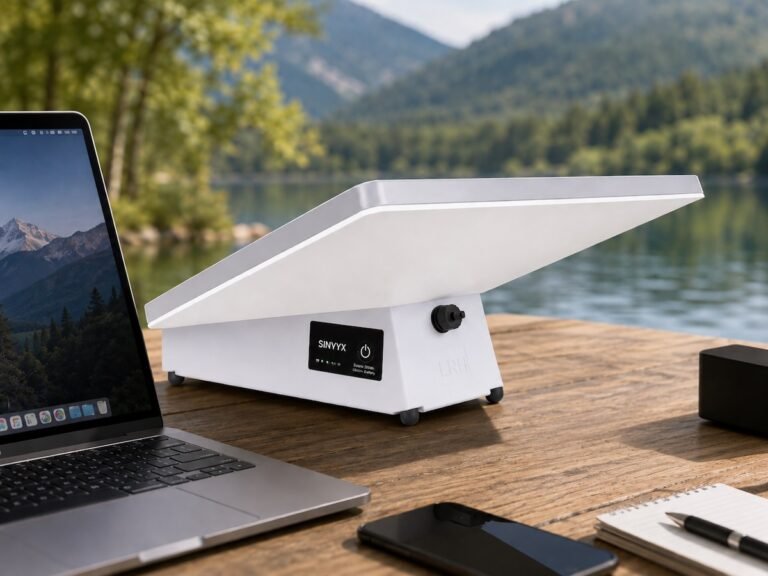
Charging a SINVYX battery while it powers Starlink Mini doesn't damage the cells — the BMS keeps the two paths separate. Here's…
Read more →
Every SINVYX spec sheet lists -20°C to 60°C as the operating range, and that number gets repeated everywhere without the one detail…
Read more →