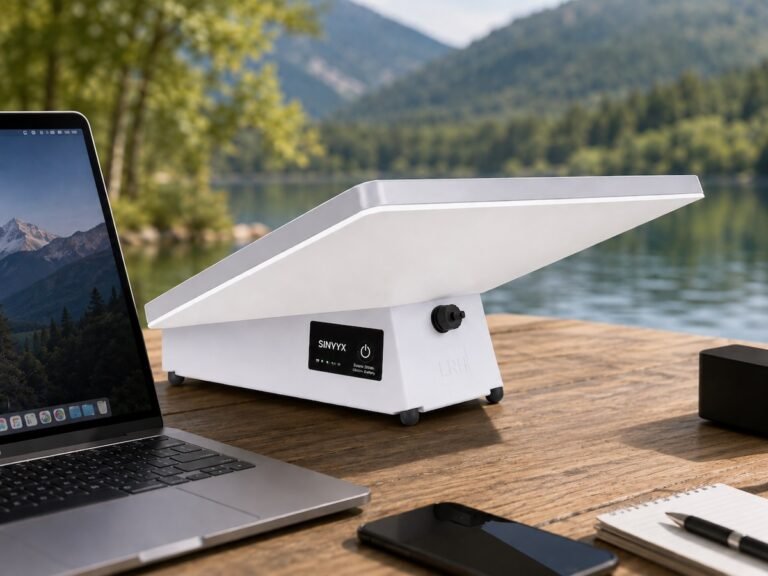
Is Pass-Through Charging Safe for Your Starlink Mini Battery? Here’s What Actually Happens
Charging a SINVYX battery while it powers Starlink Mini doesn't damage the cells — the BMS keeps the two paths separate. Here's…
Read more →
Direct answer: At Starlink’s published average Mini draw of about 25–40W, planning estimates (rated Wh × 85% usable energy ÷ load) are roughly 2.1–3.4 hours for 99Wh, 3.4–5.4 hours for 158Wh, 3.8–6.1 hours for 180Wh, and 4.2–6.8 hours for 200Wh. These are calculations, not lab guarantees. Cold weather, weak signal, settings, and battery age all change real runtime.
If you are choosing a clip-on pack for Starlink Mini, capacity is the main lever. This guide explains the math, states the assumptions, and maps each Wh tier to trips, remote work, and flight rules. For shopping, start with the Starlink Mini battery category. For brand-to-brand context, see our best Starlink Mini battery packs 2026 roundup.
Assumptions used throughout this article
On smaller screens, swipe the table sideways. Runtime columns use the same 25W (upper) and 40W (lower) planning loads.
| Capacity | Planning runtime @ 25–40W | Approx. usable Wh (×0.85) | Flight notes (spare Li-ion) | SINVYX product link |
|---|---|---|---|---|
| 99Wh | 2.1–3.4 hours | ~84 Wh | Generally under 100Wh; cabin carry-on, terminals protected; confirm airline policy | SINVYX 99Wh |
| 158Wh | 3.4–5.4 hours | ~134 Wh | 101–160Wh: airline approval; max two spare batteries in that band | SINVYX 158Wh |
| 180Wh | 3.8–6.1 hours | ~153 Wh | Above 160Wh: outside ordinary passenger-baggage spare-battery allowance | Planning tier only — not in current SINVYX live catalog (see 158Wh / 200Wh) |
| 200Wh | 4.2–6.8 hours | ~170 Wh | Above 160Wh: not for passenger carry-on or checked bags | SINVYX 200Wh |
A 99Wh Starlink Mini battery plans at about 2.1 hours at 40W and 3.4 hours at 25W under the assumptions above. That fits day hikes, short remote check-ins, and trips where cabin baggage rules matter.
The SINVYX 99Wh pack weighs about 0.79 kg, uses Samsung or LG 21700 NMC cells, outputs 15–21V DC, and is IP65 with port covers closed. It is not designed for submersion.
A 158Wh Starlink Mini battery plans at about 3.4–5.4 hours at 25–40W. That is the common “half workday / long session” tier when you can recharge later in a van, hotel, or campsite.
The SINVYX 158Wh pack weighs about 1.1 kg and uses EVE 21700 NMC cells. For flights, treat it as a 101–160Wh spare: request airline approval and keep it in the cabin with terminals protected.
Using the same formula, 180Wh × 0.85 ÷ 25–40W ≈ 3.8–6.1 hours. Some brands list a ~180Wh clip-on class; SINVYX’s current live catalog is 99Wh, 158Wh, and 200Wh. If you need more reserve than 158Wh and you are not flying, compare against the 200Wh model rather than assuming an 180Wh SKU is in stock.
A 200Wh Starlink Mini battery plans at about 4.2–6.8 hours at 25–40W — the longest continuous window in SINVYX’s clip-on lineup. It uses Samsung or LG 21700 NMC cells and weighs about 1.1 kg.
Because 200Wh is above the usual 160Wh passenger spare-battery limit, do not pack it in carry-on or checked bags for a passenger flight. It fits road trips, boats, and base-camp use where you travel by ground or water.
Browse all live capacities in the Starlink Mini batteries category, or compare other brands in the 2026 battery pack roundup.
Plan with rated Wh × 0.85 ÷ your expected watts. At Starlink’s 25–40W average range, 99Wh ≈ 2.1–3.4 h, 158Wh ≈ 3.4–5.4 h, 180Wh ≈ 3.8–6.1 h, and 200Wh ≈ 4.2–6.8 h.
Starlink lists an average range around 25–40W for Mini, with lower idle figures in some conditions. Field reports also vary by firmware, location, and traffic. Use a range, not a single watt number, when sizing a pack.
No. Current SINVYX 99Wh, 158Wh, and 200Wh product pages specify NMC 21700 cells (Samsung/LG or EVE depending on model), not LiFePO4.
Switching the Mini off between sessions stretches calendar hours, but continuous-runtime tables assume the radio stays online. Treat intermittent use as energy budgeting, not a higher continuous rating.
Only if solar (or another input) reliably supplies at least as much power as the Mini draws after losses. Cloud cover, panel angle, and temperature matter. Check the battery’s solar input range (SINVYX lists up to 100W, 20–40V PV on current packs) before relying on pass-through.
Pick capacity from the hours you need online and whether you will fly. Use the 25–40W planning band and the 85% usable-energy assumption so you compare apples to apples. Then open the exact product page for weight, cells, charging, and flight notes: 99Wh, 158Wh, or 200Wh — or shop the full category and the comparison roundup.
Charging a SINVYX battery while it powers Starlink Mini doesn't damage the cells — the BMS keeps the two paths separate. Here's…
Read more →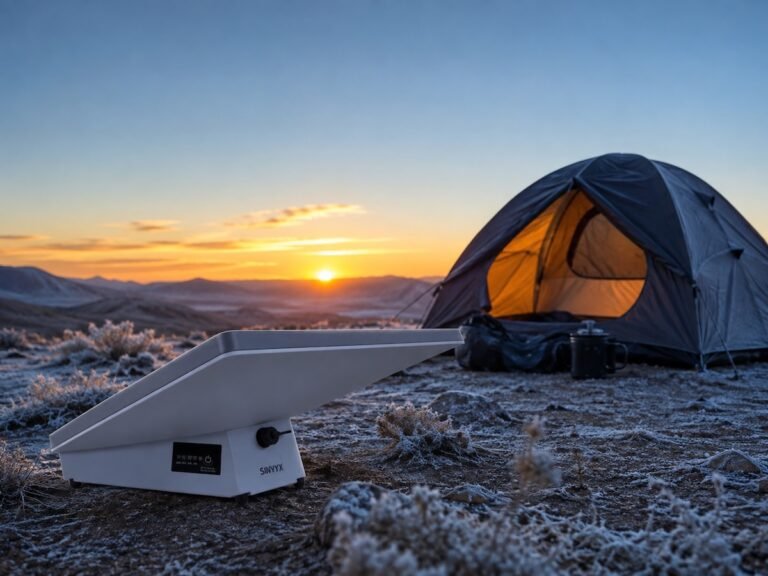
Every SINVYX spec sheet lists -20°C to 60°C as the operating range, and that number gets repeated everywhere without the one detail…
Read more →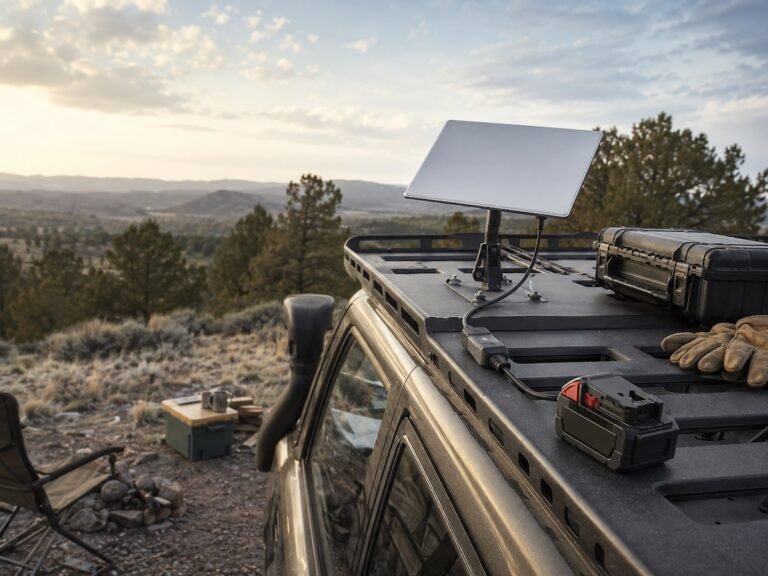
Yes, a Milwaukee M18 or DeWalt 20V battery can power Starlink Mini through a tool-battery-to-DC adapter. A 5Ah pack runs it for…
Read more →