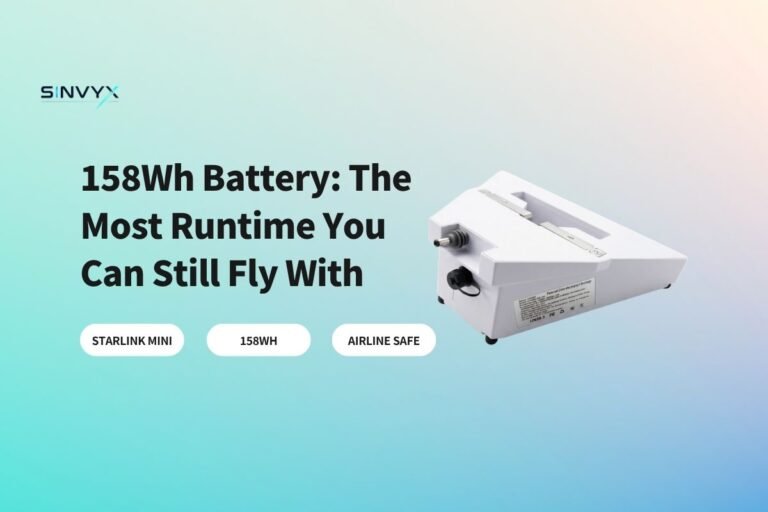
Starlink Mini 158Wh Battery: The Most Runtime You Can Still Fly With
You’re heading somewhere without reliable grid power for two or three days. The 99Wh gets you about 2–3.5 hours per charge —…
Read more →
Direct answer: For most US passenger flights, a 99Wh Starlink Mini battery is generally allowed as a spare lithium-ion pack in carry-on only (no airline approval typically required for personal use). A 158Wh pack sits in the 101–160Wh band: airline approval is required, with a common limit of two spare batteries in that band. A 200Wh pack is above 160Wh and is not allowed in ordinary passenger carry-on or checked baggage. Always confirm with your airline before you fly — rules can be stricter than the FAA baseline.
This guide maps SINVYX’s live 99Wh / 158Wh / 200Wh clip-on packs to common FAA and TSA spare-battery guidance so you can choose capacity for flights versus road trips. Shop the Starlink Mini batteries category, compare brands in our 2026 roundup, or see yesterday’s runtime planning guide for hour estimates.
Disclosure: SINVYX sells these batteries. Flight rules below are a plain-language summary of public FAA PackSafe and TSA lithium-battery guidance for US airline passengers. They can change, and airlines may add stricter limits. This is not legal advice — verify before travel.
Common US passenger rules for spare lithium-ion batteries / power banks (personal use; summarize FAA PackSafe “Airline Passengers and Batteries” and TSA lithium pages):
On smaller screens, swipe the table sideways. Runtime uses the same planning formula as our runtime article: rated Wh × 0.85 ÷ 25–40W (85% is a planning assumption, not a lab efficiency).
| Capacity | Approx. weight | Planning runtime @ 25–40W | Spare Li-ion flight notes (US) | SINVYX product |
|---|---|---|---|---|
| 99Wh | ~0.79 kg | 2.1–3.4 hours | ≤100Wh: generally cabin carry-on; protect terminals; confirm airline | SINVYX 99Wh |
| 158Wh | ~1.1 kg | 3.4–5.4 hours | 101–160Wh: airline approval; max two spares in that band; carry-on only | SINVYX 158Wh |
| 200Wh | ~1.1 kg | 4.2–6.8 hours | >160Wh: not for ordinary passenger carry-on or checked bags | SINVYX 200Wh |
Yes, for most US passenger itineraries a 99Wh Starlink Mini battery is the simplest flight-friendly spare: under 100Wh, carry-on only, terminals protected. The SINVYX 99Wh pack weighs about 0.79 kg and uses Samsung or LG 21700 NMC cells. Planning runtime is roughly 2.1–3.4 hours at 25–40W.
For a product-focused travel angle on the 99Wh tier, see also our older guide: 99Wh airline-approved portable travel-ready pack. This article stays on Wh-band rules across the lineup rather than duplicating that page.
A 158Wh Starlink Mini battery falls in the 101–160Wh band. Under common FAA guidance you may carry up to two spare batteries in that band with airline approval, in carry-on only. Request approval before travel (email or airline app/FAQ), keep the pack in the cabin, and protect terminals.
The SINVYX 158Wh pack weighs about 1.1 kg and uses EVE 21700 NMC cells. Planning runtime is about 3.4–5.4 hours at 25–40W — useful when you need a longer session after landing and can get approval in advance.
No — not as ordinary passenger baggage. A 200Wh Starlink Mini battery exceeds the usual 160Wh spare-battery ceiling for passenger aircraft. Do not pack it in carry-on or checked bags for a typical commercial passenger flight.
Use 200Wh for road trips, boats, vans, and base camps where you travel by ground or water. It uses Samsung or LG 21700 NMC cells, weighs about 1.1 kg, and plans at roughly 4.2–6.8 hours at 25–40W.
FAA and TSA set a US baseline; individual airlines (especially international carriers) often add quantity caps on power banks, require Wh labels in a specific format, or refuse 101–160Wh spares even with “approval” language on paper. Codeshare and connecting airlines can each apply their own policy. Non-US departure rules may differ. Treat the table as a planning filter, then confirm the exact itinerary with each operating carrier.
Browse live SKUs in the Starlink Mini batteries category, compare options in the 2026 pack roundup, and size hours with the runtime guide.
Usually yes for ≤100Wh spares in carry-on. 101–160Wh needs airline approval (max two spares). Above 160Wh is not for ordinary passenger baggage. Confirm your airline.
“Airline approved” is marketing shorthand. Under common FAA guidance, ≤100Wh spare Li-ion for personal use generally does not require special airline approval — but you still must carry it in the cabin, protect terminals, and follow any stricter airline policy.
Yes, under typical US rules for 101–160Wh spare lithium-ion batteries. Expect a two-spare limit in that band and carry-on only.
No for spare batteries and power banks. FAA PackSafe and TSA guidance: spares go in carry-on only. Never check a 200Wh pack either — it exceeds the passenger spare Wh ceiling.
No. Current SINVYX 99Wh, 158Wh, and 200Wh product pages specify NMC 21700 cells (Samsung/LG or EVE by model), not LiFePO4. Flight rules depend on Wh rating and spare vs installed status, not on marketing chemistry labels.
See FAA PackSafe pages on airline passengers and batteries / lithium batteries, and TSA “what can I bring” lithium battery entries. Wh limits and spare-battery cabin rules are the core checkpoints; airlines may be stricter.
Choose a Starlink Mini battery for airplane travel by Wh band first, then by hours online. Fly with 99Wh when you want the simplest cabin path; use 158Wh only with airline approval; keep 200Wh for ground and water trips. Shop the full category, compare packs in the 2026 roundup, and plan hours with our runtime guide.
You’re heading somewhere without reliable grid power for two or three days. The 99Wh gets you about 2–3.5 hours per charge —…
Read more →Yes, a 99Wh Starlink Mini battery can go in your carry-on on most flights without airline approval, because it is under the…
Read more →