
RAVION vs SINVYX: Which Starlink Mini Battery Should You Buy?
Pick RAVION Lite if you want to recharge from any USB-C charger. Pick SINVYX if you want a lower price at 99Wh…
Read more →
Starlink Mini rebooting on 12V power almost always comes down to voltage instability, not a faulty dish. A raw car 12V circuit dips under load and sags over cable distance, and Starlink Mini has a lower voltage floor it won’t run below. A step-up converter smooths some of that out — but it’s solving the symptom, not the setup. Here’s what’s actually happening, and what closes the gap completely.

Plugging Starlink Mini straight into a car’s 12V system — a cigarette lighter socket or a hardwired tap off a switch panel — is one of the most common ways owners power it off-grid. It’s also one of the most common sources of a specific complaint: the dish drops out intermittently, or the router paired with it keeps rebooting, with no clear pattern to when it happens. Some owners report it clears up the moment they switch away from a raw 12V feed to something regulated. That pattern — inconsistent on raw 12V, stable once regulated — is the actual signature of a voltage problem, not a defective unit.
Starlink Mini takes 12–48V DC input at up to 60W (full breakdown here), which technically puts 12V inside the accepted range — but at the floor of it, not comfortably inside it. Two things push a raw 12V car circuit below that floor even when the nameplate says “12V”:
Voltage sag under load. A car’s 12V rail isn’t a flat 12V — it moves with what else is drawing power on the same circuit, and it dips further the moment the load isn’t steady. Starlink Mini’s own startup draw is enough to expose that dip if the source isn’t regulating tightly.
Cable resistance over distance. The longer the run from the power source to the dish, the more voltage is lost to resistance in the wire itself. A 12V feed measured at the source can arrive several volts lower by the time it reaches Starlink Mini, especially on longer mobile installs where the cable has to route around a vehicle or rig.
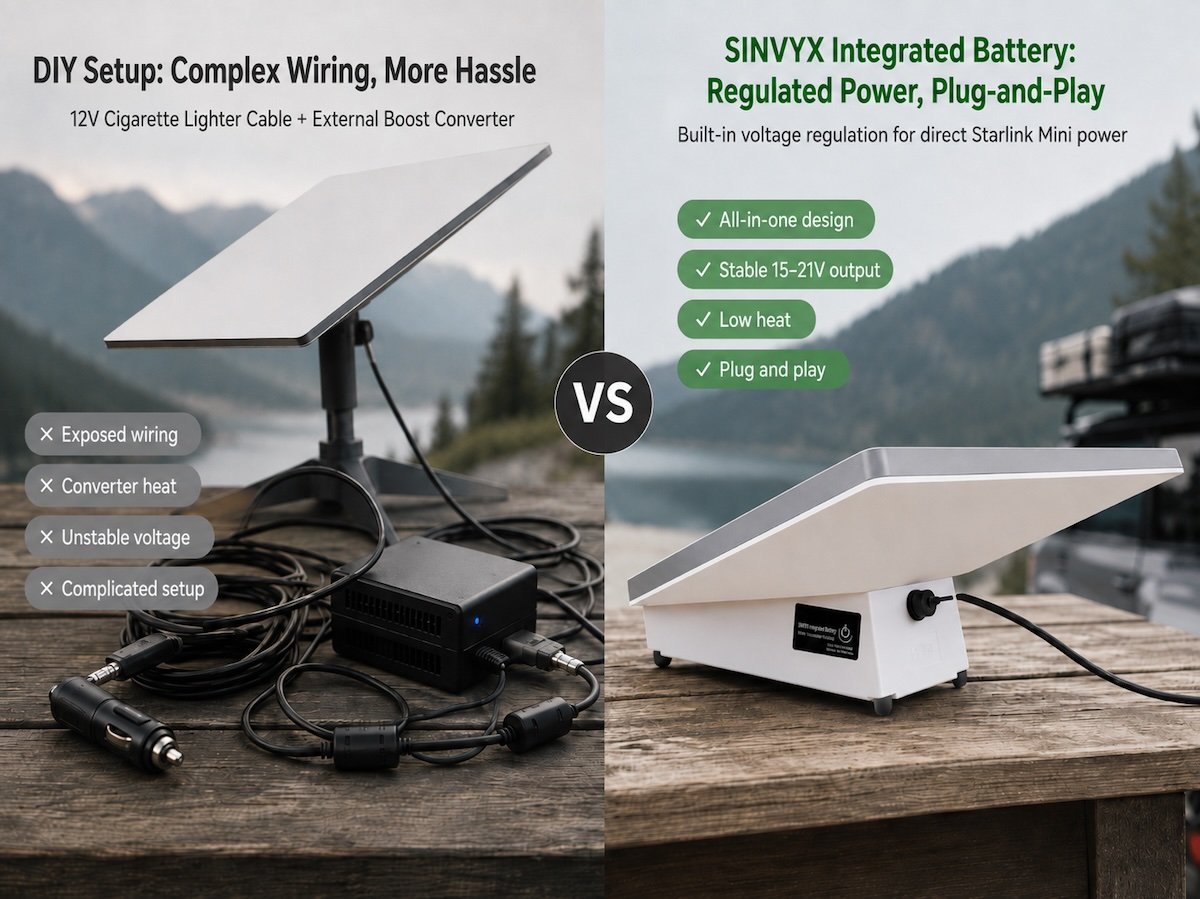
This is exactly why some owners land on a workaround: stepping the circuit up to a higher regulated voltage — commonly in the 20–24V range — rather than running Starlink Mini directly off the raw 12V line. It’s a real fix for the symptom. It also means adding a separate converter as one more component that can fail, one more thing to wire in, and one more part not covered by Starlink Mini’s own power troubleshooting.
There’s a simpler reason this trips people up in the first place: the cable that ships with a proper 12V accessory setup usually has a step-up converter built into it. Wiring straight into a car’s 12V line — skipping that factory cable — is what removes the regulation and exposes the dip. The fix people find on their own (add a step-up converter) is really just replacing what got skipped.
Running Starlink Mini off an AC outlet — including through a portable power station’s built-in inverter — looks like the simplest option. It’s also the least efficient one, and by a wide margin.
One owner ran a controlled six-hour comparison test powering Starlink Mini from a portable power station, testing AC, USB-C, and DC inputs back to back. AC power drew roughly 34% of the battery’s capacity over six hours. USB-C and direct DC power, tested under the same conditions, used about 21% — putting AC at roughly a third more battery drain for the exact same six hours of runtime.
The reason is straightforward: an AC inverter has to convert DC battery power to AC, then whatever’s charging or powering Starlink Mini converts it back to DC again. Every conversion step loses energy as heat. A direct DC connection skips both conversions entirely — there’s simply less to lose. This is the same reason a dedicated DC battery beats a USB-C power bank for Starlink Mini: fewer conversion steps between the battery and the dish, less lost along the way.
A step-up converter fixes the voltage number. It doesn’t remove the underlying issue: you’re still running a DIY power chain built from parts that weren’t designed to work together, with one more connection point that can work loose or fail.
SINVYX batteries output a regulated 15–21V DC directly to Starlink Mini — inside its accepted range with real margin, not sitting at the floor the way raw 12V does. There’s no AC inverter step, no separate step-up converter to wire in and maintain, and no long cable run losing voltage between a car battery and a roof-mounted dish. It’s not an accessory that patches a 12V setup — it’s the setup, built around what Starlink Mini actually needs from the start.
Why does Starlink Mini reboot when powered from a car’s 12V outlet?
It’s almost always voltage instability — the 12V rail dips under load and loses more voltage over a longer cable run, pushing the actual voltage at the dish below what it needs to stay powered.
Does a 12V-to-24V step-up converter fix Starlink Mini reboots?
It often helps, since it delivers a more stable, higher voltage than a raw 12V line. It doesn’t remove the underlying issue — you’re adding another component to a DIY chain instead of starting from a supply built to Starlink Mini’s actual voltage range.
Is it more efficient to power Starlink Mini with AC or DC?
DC is meaningfully more efficient. In one owner’s controlled six-hour test, AC power (via an inverter) used about 34% of the battery, versus roughly 21% for direct DC or USB-C. Every AC-DC conversion step loses energy as heat that a direct DC connection skips entirely.
What voltage does Starlink Mini actually need?
Starlink Mini accepts 12–48V DC, but 12V sits at the low end of that range with little margin. SINVYX batteries output a regulated 15–21V, which is why they don’t show the same voltage-sag issues raw 12V circuits do.
A raw 12V car circuit or an AC inverter can technically power Starlink Mini, but neither delivers the steady voltage it needs to stay online without dropping out. A step-up converter narrows that gap. A purpose-built battery that outputs a regulated 15–21V DC directly — no inverter, no separate converter, no long cable run to lose voltage over — closes it. If you’re deciding which one, here’s how to pick the right capacity, and here’s how SINVYX compares to the other purpose-built option on the market.
Pick RAVION Lite if you want to recharge from any USB-C charger. Pick SINVYX if you want a lower price at 99Wh…
Read more →
Find the best battery for Starlink Mini. Compare 8 packs by capacity, weight, runtime assumptions, mounting and flight limits.
Read more →