
Starlink Mini Battery Runtime: How Long 99–200Wh Last
Planning estimates for Starlink Mini battery runtime at 99Wh, 158Wh, 180Wh and 200Wh, with stated assumptions and capacity tips.
Read more →
Short answer: a portable power station is the better choice when you need a full day or more of power for Starlink Mini and other gear, and you don’t mind carrying 5–15 kg. A clip-on Starlink Mini battery is the better choice when you’re moving, flying or setting up fast, because it mounts on the dish, feeds it DC directly and weighs about 1 kg. Many people end up using both: the power station at base camp, the clip-on battery when they walk away from it.
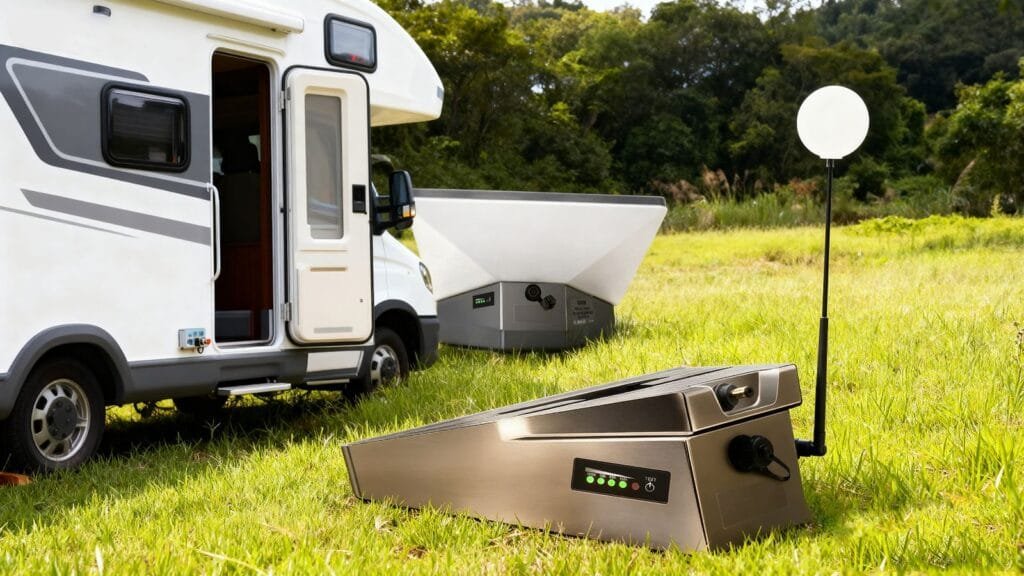
| Portable power station | Clip-on Starlink Mini battery | |
|---|---|---|
| Typical capacity | 250–2,000Wh+ | 99–200Wh |
| Typical weight | 3–20 kg | About 0.8–1.1 kg (SINVYX range) |
| How it powers the Mini | USB-C PD (100W port needed), 12V DC car port, or AC through the Starlink power supply | DC directly into the Mini (SINVYX: 15–21V DC) |
| Mounting | Sits on the ground or in the vehicle, with a cable to the dish | Clips onto the back of the Mini |
| Powers other devices | Yes: laptops, fridges, lights, phones | Built for Starlink Mini |
| Weather | Most are made for indoor or sheltered use | SINVYX packs are IP65 with the port covers closed |
| Flying | Almost always above the 160Wh passenger limit | 99Wh flies without approval; 100–160Wh needs airline approval |
Use the same planning formula as for any battery: runtime (hours) ≈ capacity Wh × efficiency ÷ average watts. Starlink lists an average draw of 25–40W for the Mini.
The efficiency number depends on how you connect it:
| Power station size | DC / USB-C at 25W | DC / USB-C at 40W | AC at 40W (~72%) |
|---|---|---|---|
| 300Wh | ~10 h | ~6.4 h | ~5.4 h |
| 500Wh | ~17 h | ~10.6 h | ~9 h |
| 1,000Wh | ~34 h | ~21 h | ~18 h |
These are planning estimates, not measured results. Cold weather, battery age and the Mini’s snow-melt heater all shorten runtime. For the full breakdown of Starlink Mini’s consumption, see our Starlink Mini power requirements guide.
A common setup for van life and overlanding is a power station in the vehicle and a clip-on battery on the dish. Recharge the clip-on battery from the power station overnight, then take the Mini anywhere during the day without a cable back to the vehicle. If you also have solar, see how to charge a Starlink Mini battery with solar.
A power bank sits between the two: lighter than a power station, but most can’t supply the 100W USB-C PD that Starlink Mini needs. We cover that comparison in dedicated battery vs USB-C power bank for Starlink Mini.
What size power station do I need for Starlink Mini?
Multiply your hours online by 25–40W and divide by about 0.85 for DC or USB-C, or about 0.72 for AC. Eight hours at 30W over USB-C needs roughly 280Wh, so a 300Wh station is the smallest sensible size.
Can I plug Starlink Mini into a power station’s AC outlet?
Yes, using the Starlink power supply. It works, but you lose more energy than with the USB-C or 12V DC output.
Will a 12V car port on a power station run Starlink Mini?
Yes. The Mini accepts 12–48V DC. Use a short, thick cable to avoid voltage drop at the 60W peak.
Can I take a power station on a plane?
Usually not. Most power stations are well above 160Wh, which is outside the normal passenger allowance. A 99Wh clip-on battery is the travel-friendly option.
Pick a power station for all-day, one-spot power that also runs your other gear. Pick a clip-on battery for mobile, weather-exposed or air-travel setups. If you’re choosing a clip-on battery, compare the options in our best battery for Starlink Mini guide or browse the SINVYX Starlink Mini batteries.
Planning estimates for Starlink Mini battery runtime at 99Wh, 158Wh, 180Wh and 200Wh, with stated assumptions and capacity tips.
Read more →
Charging a SINVYX battery while it powers Starlink Mini doesn't damage the cells — the BMS keeps the two paths separate. Here's…
Read more →
Every SINVYX spec sheet lists -20°C to 60°C as the operating range, and that number gets repeated everywhere without the one detail…
Read more →