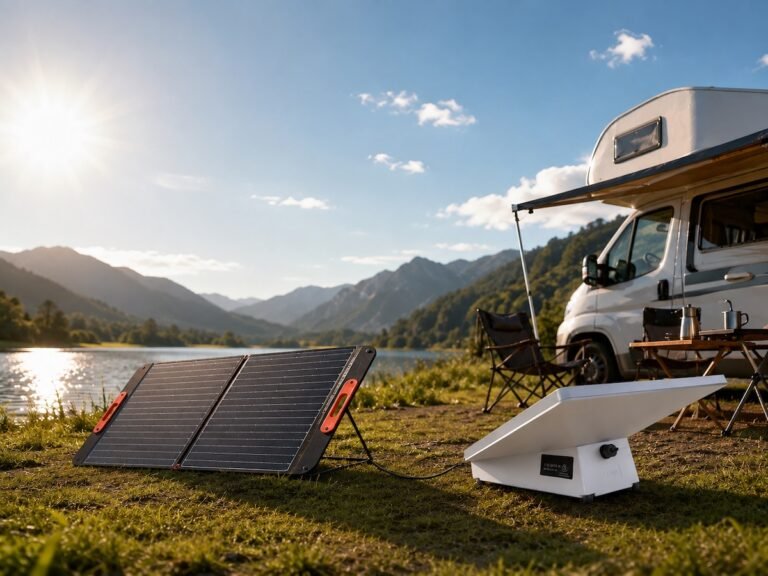
Starlink Mini Battery Solar Charging: How Fast Does It Charge & What Panel Works?
Direct answer: A SINVYX Starlink Mini battery accepts solar input up to 100W at 20–40V. Realistic solar charge times land close to…
Read more →
Short answer: Starlink Mini runs on 12–48V DC and is rated for 60W. Starlink’s official specification sheet lists an average draw of 25–40W. On a 12V system that works out to about 2–3.5A on average and up to 5A at peak. If you power it over USB-C, you need a USB PD source rated at least 100W (20V/5A) with Starlink’s USB-C cable. Size your battery for the 60W peaks, not just the average, and keep 12V cable runs short and thick.

This guide brings together everything you need to plan power for Starlink Mini: how many watts it uses, what voltage and current it needs, how long a battery will last, and which power sources work in the field.
| Specification | Value | What it means for you |
|---|---|---|
| DC input range | 12–48V DC | Works from 12V vehicle systems up to 48V telecom or home-battery rails |
| Input rating | 60W | Your source must handle 60W peaks without the voltage sagging |
| Average consumption | 25–40W (official spec) | Use this range to plan battery capacity |
| USB-C PD requirement | 100W, 20V/5A minimum | Applies when using Starlink’s USB-C to barrel jack cable |
| Connector | DC barrel jack, center positive | Check polarity with a multimeter before connecting a DIY cable |
Starlink Mini’s draw changes with what it is doing. Start-up, satellite acquisition and the snow-melt heater pull the most; steady browsing pulls far less. Many owners report draws at the low end of the official range in mild weather, but plan with the official numbers so cold days and heavy use don’t catch you out.
| Operating condition | Typical draw | Notes |
|---|---|---|
| Idle / light use | 15–20W | Connected with little data traffic |
| Average use | 20–40W | Browsing, video calls, streaming |
| Start-up / heavy load | 40–60W | Booting, searching for satellites, heavy traffic |
| Snow-melt mode | Up to ~60W | The built-in heater runs in freezing conditions |
Daily energy use: at a steady 25W, Starlink Mini uses about 600Wh in 24 hours; at 40W, about 960Wh. Most people don’t run it around the clock, so multiply your average watts by the hours you’ll actually be online.
Use this planning formula: runtime (hours) ≈ battery Wh × 0.85 ÷ average watts. The 0.85 factor is a planning assumption for conversion and cable losses, not a measured result. Cold weather, battery age and the snow-melt heater all shorten runtime.
| Battery capacity | At 25W | At 40W | At 60W (peak) |
|---|---|---|---|
| 99Wh | ~3.4 h | ~2.1 h | ~1.4 h |
| 158Wh | ~5.4 h | ~3.4 h | ~2.2 h |
| 200Wh | ~6.8 h | ~4.2 h | ~2.8 h |
| 500Wh power station | ~17 h | ~10.6 h | ~7.1 h |
To pick a battery size around these numbers, see our comparison of 8 Starlink Mini battery packs, or go straight to the SINVYX Starlink Mini batteries (99Wh, 158Wh and 200Wh).
Power (W) = voltage (V) × current (A). At low voltage, Starlink Mini pulls more current for the same 60W, and more current means more voltage drop in the cable. If the voltage at the dish dips too low under load, it reboots.
| System voltage | Current at 60W | Cable guidance | Typical use |
|---|---|---|---|
| 12V | 5.0A | 14 AWG or thicker, keep runs short | Cars, vans, 12V boat systems |
| 24V | 2.5A | 16 AWG is usually fine | RVs, trucks, off-grid systems |
| 48V | 1.25A | Thin cable, minimal drop | Telecom sites, home battery systems |
Approximate voltage drop on 16 AWG copper cable at 20°C (round trip):
| Cable length | Drop at 12V / 5A | Drop at 24V / 2.5A | Verdict |
|---|---|---|---|
| 5 ft (1.5 m) | ~0.20V | ~0.10V | Fine for vehicles |
| 15 ft (4.5 m) | ~0.60V | ~0.30V | Borderline at 12V |
| 30 ft (9 m) | ~1.21V | ~0.60V | Unreliable at 12V |
For runs longer than about 10 ft on a 12V system, use thicker cable or a DC-DC step-up converter to 24V. Our guide to why Starlink Mini keeps rebooting on 12V covers this in detail.
How many watts does Starlink Mini use?
Starlink lists an average of 25–40W, with a 60W input rating for start-up, heavy load and snow melt. Light use often sits around 15–20W.
Can Starlink Mini run on 12V?
Yes. Its input range is 12–48V DC. On 12V it can pull up to 5A, so use a thick, short cable or step up to 24V for longer runs.
What USB-C power bank do I need for Starlink Mini?
One whose port supports USB PD at 100W (20V/5A), used with Starlink’s USB-C cable. A 60W or 65W bank may not boot the Mini reliably.
How long will a 100Wh battery run Starlink Mini?
About 2–3.5 hours at a 25–40W average, using the 85% planning factor above. Lighter use runs longer; cold weather runs shorter.
Does Starlink Mini have a built-in battery?
No. It needs an external power source: the included power supply, a USB-C PD source, a 12–48V DC supply or a dedicated battery.
Power Starlink Mini with a stable 12–48V DC source that can deliver 60W without sagging, or a 100W USB-C PD source. Plan battery capacity around 25–40W, keep 12V cables short and thick, and use a battery buffer for solar. If you want a battery that clips on and feeds the Mini directly, compare the 99Wh, 158Wh and 200Wh SINVYX batteries.
Direct answer: A SINVYX Starlink Mini battery accepts solar input up to 100W at 20–40V. Realistic solar charge times land close to…
Read more →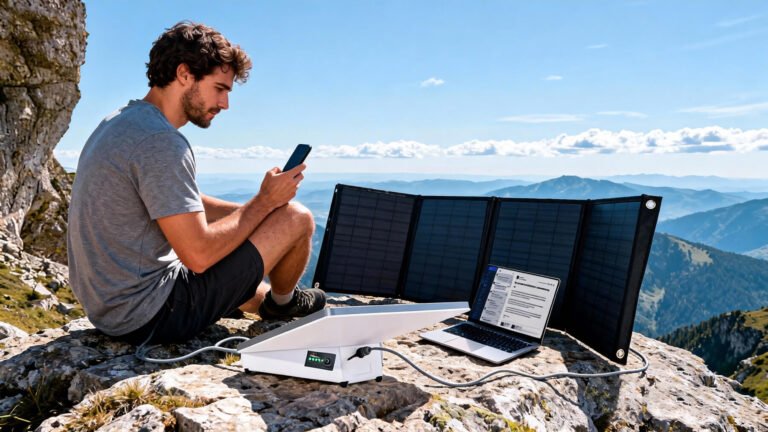
As Starlink Mini adoption continues to grow among campers, overlanders, RV users, field engineers, and emergency teams, one question comes up again…
Read more →
Field operations demand reliable connectivity, but unstable power can derail a critical mission. A sudden power drop means lost data, failed communications,…
Read more →